Every long-term investor is asking one important question – What is the HDFC Bank share price target in 2026 and is still a strong long-term investment opportunity? After the historic mega merger of Housing Development Finance Corporation Limited into HDFC Bank, investors are closely tracking its latest financial performance, valuation metrics, and updated share price target.
HDFC Bank 🏦 is one of India’s largest and most trusted private sector banks, known for its strong fundamentals, consistent profit growth, and long-term wealth creation track record.
In this detailed HDFC Bank share analysis blog, we are going to cover the latest financial performance, merger impact, future growth prospects, associated risks and share price target.
Disclaimer: The financial data mentioned in this blog is based on publicly available results and annual reports as of March 2025. Stock market investments are subjects to market risks. Investors are advised to analyse the latest quarterly results and consult a financial advisor before making any investment decisions.
HDFC Bank Company Overview
HDFC Bank is one of the most trusted and leading private banks in India. It was established in 1994 as HDFC Bank Limited, and has grown rapidly over the past three decades. The bank is headquartered in Mumbai and it operates a wide network of branches and ATMs across India.
After the historic merger with HDFC Ltd in 2023, HDFC Bank has become one of the largest financial institutions in India in terms of market capitalisation and total assets. It serves millions of customers, including individuals, small businesses, large companies, and government institutions.
HDFC Bank operates 9,000+ branches and 21,000+ ATMs and cash recyclers across India.
HDFC Bank share is a popular investment choice for long-term investors due to its strong financial performance, consistent profit growth, high asset quality, and disciplined risk management. Over the years, it has maintained healthy profitability ratios and a strong balance sheet, which makes it one of the most stable and reliable banking stocks in India.
HDFC Bank share Price Overview
The HDFC Bank share price is currently trading around ₹ 857, making it one of the stable and widely followed stocks in the Indian stock market. After the historic merger between HDFC Limited and HDFC Bank, the bank becomes the largest private sector Bank in India by market capitalisation of around ₹ 13,18,579 crores. Over the past few years, the HDFC Bank share price has shown relatively stable performance compared with many other banking stocks in India.
For a long-term investment perspective, investors generally view the current price levels as relatively reasonable compared with the bank’s historical valuation. HDFC Bank has traditionally traded at a premium valuation because of its strong fundamentals, consistent earnings growth, and relatively low non-performing assets.
Because of these strong fundamentals and market leadership, investors closely track the HDFC Bank share price target for the coming years. As the bank continues to expand its loan portfolio and integrate benefits of the merger, investors remain confident about its long-term growth potential.
HDFC Bank Business Model
As an investor, if you are analysing HDFC Bank share, it is important to understand its business model. Its long-term performance depends on how efficiently it generates revenue, manages risk, and maintains profitability.
HDFC Bank’s business model is based on a simple but highly efficient banking structure. It raises deposits at low cost and invests them in a variety of loan products to generate sustainable profits. This disciplined and scalable business model supports consistent earnings growth and strengthens the long-term investment potential of HDFC Bank share.
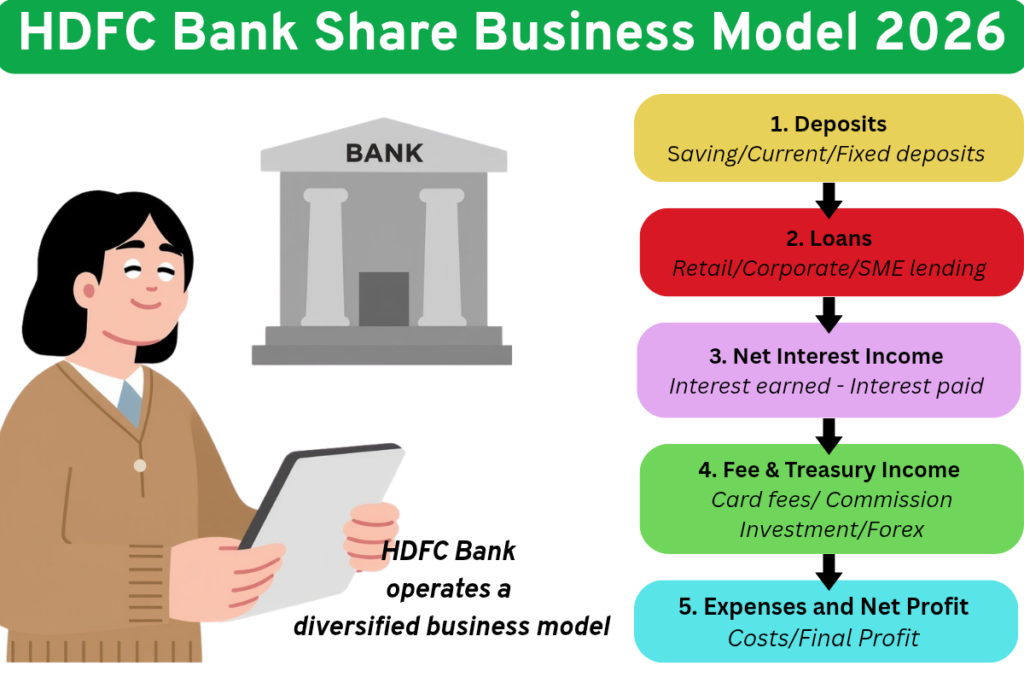
- HDFC Bank collect funds from customers through savings, current & fixed accounts.
- The Bank uses these collected deposit funds to provide loans such as home loans, personal loans, business loans, and corporate financing. Loans generate interest income, which is the main earning source of the bank.
- The difference between interest earned on loans and interest paid on deposits is called Net Interest Income.
- Apart from loan interest income bank earns a lot from Card fees, Forex transactions, Treasury operations and Commission from insurance and investment products.
- After earning total income, the bank deducts operating expenses such as employee salaries, technology investment, and loan provisions. The remaining amount becomes its Net Profit.
In simple terms we can say that, “ It earns by borrowing money at lower rates and lending at higher rates with proper risk management.”
Business Segments of HDFC Bank
HDFC Bank operates three business segments, Retail banking, Wholesale banking, and Treasury operations, that help it to generate stable revenue, manage risk efficiently, and maintain long-term profitability.
1. Retail Banking
Retail banking is the biggest revenue source of HDFC Bank. This segment provides financial services directly to individual customers, salaried professionals, and small businesses. It provides a comprehensive range of products and services, including savings and current accounts, credit card, debit card, fixed deposits and a range of loan options for personal and business purpose.
2. Wholesale Banking
Wholesale banking targets a wide range of customers, including Large companies, Multinational companies, Public sector companies, and SMEs. It provides a comprehensive end-to-end financial services and products such as loans, deposits, payments, collections, tax solutions,trade finance, corporate cards and cash management solutions.
HDFC Bank has built a strong reputation for delivering quality and reliable services to its customers.
3. Treasury
The Treasury department manages the bank’s cash and invests surplus funds in safe financial assets. The Treasury team helps the bank stay financially strong and earn consistent profits with proper risk management.
HDFC Bank Financial Performance Analysis
HDFC bank shares are becoming financially strong with consistent revenue, high profitability, and strong financial stability, that makes it a stable and reliable investment choice for long-term investment.
Strong Revenue Growth
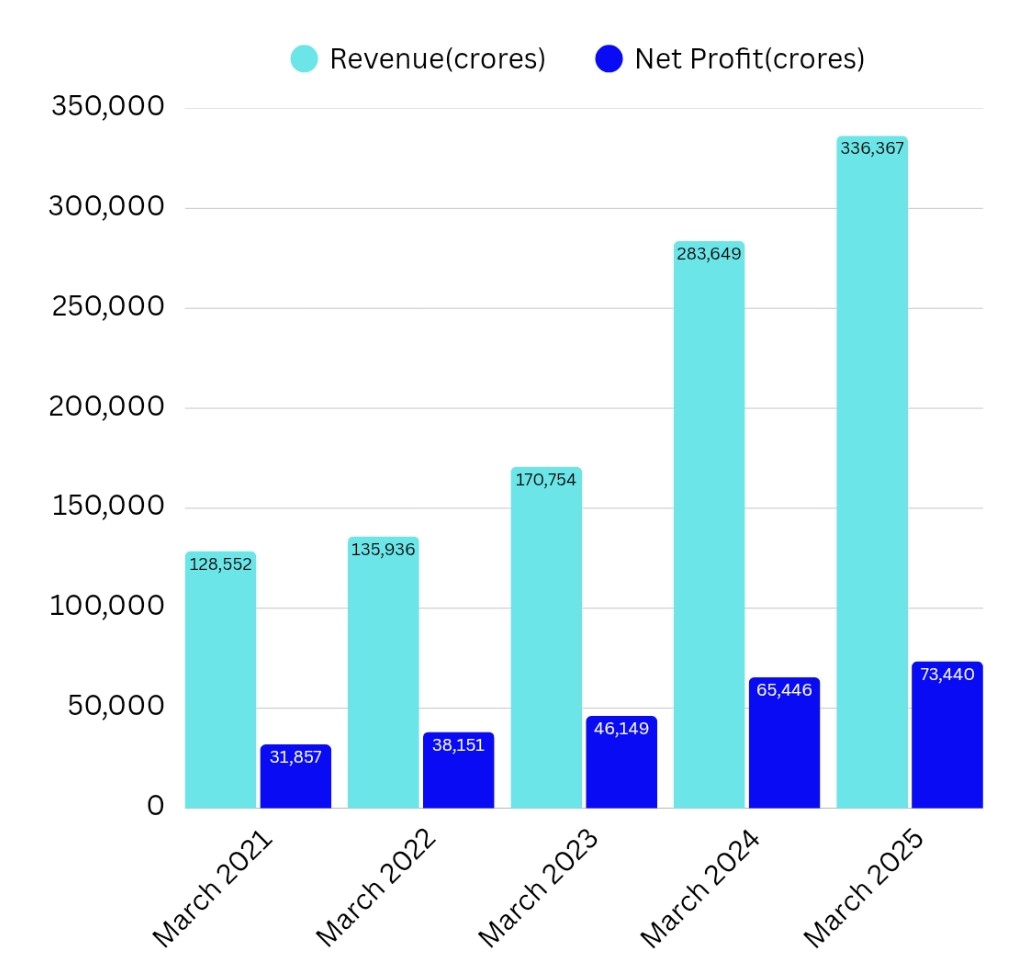
HDFC Bank has shown strong and consistent revenue growth over the past five financial years, delivering approximately 22% Revenue CAGR. This reflects its strong business model and expansion of its loan portfolio.
The Bank earns primarily from interest on loans such as home loans, personal loans, auto loans, and corporate financing, this is called Net Interest Income.
March 2021 | March 2022 | March 2023 | March 2024 | March 2025 | |
Revenue (crores) | 128,552 | 135,936 | 170,754 | 283,649 | 336,367 |
The strong revenue growth in FY2024 and FY2025 was due to growth in loan book, expansion in retail and corporate banking, enhanced digital banking services.
Consistent Profit Growth
Along with strong revenue growth, HDFC Bank has also delivered consistent growth in net profit over the past five financial years. Its profit has grown at ab impressive 21% CAGR over the past five financial years, reflecting its efficient cost management and operational efficiency.
March 2021 | March 2022 | March 2023 | March 2024 | March 2025 | |
Profit (crores) | 31,875 | 38,151 | 46,149 | 65,446 | 73,440 |
The Bank has delivered consistent profit growth due to controlled operating expenses, high credit demand, and rising Net Interest Income(NII).
The significant profit growth, especially in FY2024 and FY2025, indicates strong credit growth, improved asset quality, and rising Net Interest Income. This consistent growth in HDFC Bank’s net profit strengthens investor’s confidence and supports long-term growth of HDFC Bank share.
Strong Balance Sheet
The strong and healthy balance sheet of HDFC Bank supports long-term growth, improves investor confidence, and strengthens overall its financial performance. A strong balance sheet attracts long-term investors and enhance the stability of HDFC Bank share.
- HDFC Bank has consistently maintained strong deposit growth. Which ensures stable funding and improves Net Interest Margin Stability(NIM).
- The bank has shown steady advances growth across retail loans, home loans, personal loans, and corporate banking reflecting sustainable credit expansion.
Overall, the strong balance sheet of HDFC Bank shows its financial strength, stable growth, and effective risk management, making it a fundamentally strong investment choice.
Financial Ratio Analysis of HDFC Bank Share
Financial ratio analysis helps investors to understand the profitability, efficiency, stability, and risk of the bank. All the financial ratios mentioned below are based on the latest available data as of February 2025 and will be updated periodically.
Stock P/E
The P/E ratio of HDFC Bank is around 17.8, it shows that investors are paying ₹17.8 for every ₹1 of the bank earnings. This indicates a moderate valuation level and reflects market expectations of steady earnings growth and strong financial performance.
Return on Equity (ROE)
ROE shows how efficiently the bank generates profit from shareholders’ funds. ROE of HDFC Bank shares is approx 19, which indicates good profitability and efficient capital utilisation.
Return on Assets (ROA)
ROA mesures how effectively the bank uses its total assets to generate profit. ROA of HDFC Bank is 1.79%, which indicates it’s operational efficiency and disciplined asset management.
Debt-to-Equity Ratio
The debt-to-equity ratio of HDFC Bank is around 6.20, which shows that the bank uses a high level of debt funds in comparison to shareholders’ equity.
EPS growth 5years
The 5 years EPS growth of HDFC Bank is around 13.2%, it shows steady expansion in earnings and strong profitability.
Peer comparison of HDFC Bank 2026
Before investing in HDFC Bank, it is necessary to compare its financial performance with other leading banks, such as ICICI Bank, Axis Bank, IDBI Bank, and Kotak Mahindra Bank. These banks are competitors of HDFC Bank in similar segments including retail banking, corporate banking, and digital banking services.
Market Cap | Net profit | ROE% | ROCE% | P/E ratio | Debt to equity | |
HDFC Bank | 13,26,648 crores | 73,440 crores | 14.4% | 7.51% | 17.8 | 6.20 |
Axis Bank | 4,08,843 crores | 28,191 crores | 16.3% | 7.11% | 15.6 | 7.40 |
IDBI Bank | 1,17,040 crores | 7,656 crores | 13.6% | 6.78% | 12.6 | 4.81 |
Kotak Mahindra Bank | 3,99,146 crores | 22,126 crores | 15.4% | 8.17% | 21.2 | 3.62 |
ICICI Bank | 9,40,050 crores | 54,569 crores | 17.9% | 7.87% | 17.8 | 5.51 |
Competitive Advantages of HDFC Bank
Competitive advantages of a company represent the key strengths that allow it to perform better than its competitors over the long term. HDFC Bank has several strong competitive advantages that help it stand apart from its competitors. These advantages support consistent growth, high profitability, financial stability, and long-term investor confidence, making HDFC Bank long-term investment choice.
1. Strong Brand Value and Customer Trust
One of the biggest competitive advantages of HDFC Bank is its strong brand value and high level of customer trust. Its strong reputation attracts millions of customers across various banking services.
High customer trust strengthens HDFC Bank share performance by ensuring consistent revenue growth and long-term financial stability, making it a reliable banking stock for long-term investors.
2. Wide Distribution Network
HDFC Bank has a strong distribution network with an extensive presence across urban, semi-urban, and rural areas of India. It operates over 9,000 branches and more than 21,000 ATMs and cash recyclers across India. Its wide network helps the bank efficiently reach millions of customers.
With a customer base of over 9 crores, HDFC Bank continues to support steady business expansion and strengthen long-term performance of the HDFC Bank share.
3. Strong Digital Banking Capabilities
HDFC Bank has a significant competitive advantage over its competitors because of its advanced digital banking services. Customers can easily manage their accounts, make payments, and access loans using mobile banking, UPI, or internet banking. The Bank is continuously investing in technologies, that strengthens its competitive position in banking sector and supports sustainable long-term growth.
These seamless digital services improve convenience, build customer trust, attract digitally active users, and making HDFC Bank share a long-term investment choice for investors seeking steady growth and financial stability.
4. High Asset Quality and Risk Management
HDFC Bank stands out from its competitors due to its high asset quality and strong risk management practices. It evaluates loans carefully, monitors credit exposure, and maintains low levels of non-performing assets, ensuring its financial health remains strong.
These disciplined practices minimise potential losses, protect investors’ interests, supports long-term growth and strengthen investor confidence.
5. Diversified Business Model
HDFC Bank operates a diversified business model across retail banking, corporate banking, and treasury services. Its business model helps it to generate steady revenue from multiple sources, reduces its dependency on any single segment.
Even during economic fluctuations, HDFC Bank can maintain its financial stability because of its diversified business model, and making HDFC Bank share a reliable choice for long-term investors.
HDFC Bank share Growth Potential
The growth potential of HDFC Bank shares is supported by strong fundamentals, merger benefits, digital expansion, and favourable economic conditions in India. Investors who are looking for a stable and consistently growing stock, HDFC Bank shares can be a promising long-term investment opportunity.
1. Strong Financial Performance of HDFC Bank Share
The strong financial performance of HDFC Bank share reflects its ability to consistently grow its revenue, profits, and overall business operations over the years. Financial performance is one of the most important factors you have to analyse before investing in it, as it directly influences long-term share price growth.
- HDFC Bank has shown steady revenue growth supported by its growing loan portfolio and customer base.
- It also delivered consistent profit growth, due to efficient cost management, controlled operating expenses, and better asset quality.
- It maintains healthy asset quality with relatively low non-performing assets (NPAs), which indicates its strong risk management.
Overall, HDFC Bank’s strong financial growth and healthy asset quality show its efficient risk management, supporting stable business expansion and long-term sustainability.
2. Market Leadership of HDFC Bank in Indian Banking Sector
HDFC Bank is a leading private sector bank in India, with a strong competitive position supported by its large customer base, business scale, financial strength, and operational efficiency. Its leadership position supports sustainable business expansion and enhances investors’ confidence in HDFC Bank shares.
- HDFC Bank has a wide distribution network across urban, semi-urban, and rural regions of India.
- Its strong presence across savings accounts, loans, credit & debit cards, and digital banking services allows it to maintain its leading position in banking sector.
- HDFC Bank has emerged as a leading player in digital banking through mobile banking application, online payment systems, and digital lending platforms. Its digital ecosystem attracts digitally active users and reduce operating costs.
- HDFC Bank’s brand leadership helps it sustain customers loyalty even in a competitive banking environment, ensuring steady revenue growth and supporting long-term business growth.
HDFC Bank’s large customer base, extensive network, digital capabilities, and trusted brand position enables the bank to sustain business expansion over time. Its leading position supports stable profit growth and long-term value creation for investors.
3. Impact of HDFC and HDFC Bank Merger
The Merger of HDFC Ltd and HDFC Bank has strengthened HDFC Bank’s overall long-term growth potential by expanding its business scale, customer base, and lending capabilities.
- One of the biggests impact of the merger is the significant expansion of HDFC Bank’s loan book. HDFC Ltd was a leader in home loans, and after the merger, HDFC Bank gained direct access to a large housing loan portfolio.
- This merger combined millions of customers, creating a large customer base. HDFC Bank can now offer multiple financial products such as savings accounts, insurance, credit cards, and investment services to existing home loan customers.
- HDFC Bank benefits a lot from improved access to low-cost deposits through its wide banking network. Strong deposit base helps reduce funding costs and improve NIM.
The merger has significantly strengthened the bank’s business model by expanding its loan portfolio, improving funding strength, and creating cross-selling opportunities. Over the long-term, this merger enhances growth visibility and boost investors confidence in HDFC Bank shares.
4. Digital Transformation and Technological Advancements
Digital transformation and technological advancements have become key growth drivers for HDFC Bank, supporting long-term business expansion and improving operational efficiency. HDFC Bank continues to invest in technology to meet changing customer’s demands.
- HDFC Bank offers advanced mobile banking app and internet services that enhances customers convenience and customer satisfaction.
- The bank actively promotes digital payment systems such as UPI, online transactions, contactless payments.
- Its digital lending platforms enable quick loan approvals using automated credit assessment systems.
- The Bank uses data analytics and artificial intelligence to understand customer behaviour and offer personalised financial products, improve customer loyalty and cross-selling opportunities.
- Digital banking helps it to reach customers in semi-urban and rural areas where branch access is limited.
Digital transformation and technological advancements enables HDFC Bank to enhance efficiency, improve customer experience, and drive long-term growth.
5. India’s Economic Growth Supporting HDFC Bank’s Future Expansion
India’s s strong economic growth creates long-term growth opportunities for HDFC Bank by supporting rising credit demand and growing financial inclusion.
- Growing employment opportunities and rising disposable income results in increased demand of banking services such as savings accounts, personal loans, home loans, and credit cards.
- Rapid Urbanisation is promoting the formal banking system, enabling HDFC Bank to expand its presence in semi-urban and rural areas, supporting long-term business growth.
- India’s economic expansion increases demands for credit products such as home loan, personal loan, auto loan and business loan, supporting long-term growth opportunities for HDFC Bank.
India is well positioned to become a major global economy, and banking services are expected to expand significantly. HDFC Bank is in a strong position to benefit from this long-term structural opportunity. Strong economic growth supports business expansion, higher credit demand, long-term value creation for HDFC Bank.
Key Risks Factors Affecting HDFC Bank share Price Performance
HDFC Bank is considered as one of the strongest and most stable private sector banks in India, before investing in it you have to understand that every investment carries certain risks. These risk factors can influence the bank’s profitability, growth outlook, and future share performance.

1. Interest Rate Fluctuation Risk
Changes in RBI policies can affect lending rates and deposit costs. If deposit rates rise faster than loan interest rates, the bank’s margins may come under pressure and impact earnings growth, as banking profitability heavily depends on interest rate movements.
2. Asset Quality and Credit Risk
HDFC Bank maintains strong asset quality with relatively low non-performing assets (NPAs) reflecting its disciplined lending and risk management approaches. At the same time, during economic slowdowns, borrowers may face repayment challenges, leading to high loan default. Rising NPAs can effect profitability of HDFC Bank share.
3. Regulatory and Policy Risk
The Bank operates under strict regulations set by Reserve Bank of India. Any changes in capital requirements, lending rules or regulatory requirements can impact operational flexibility and overall profitability.
4. Increasing Competition in Banking Sector
There is high competition in Indian banking sector, increasing Competition can effect its loan growth portfolio, and its market share price.
5. Economic and Market Risk
HDFC Bank share’s performance is closely linked to overall economic conditions, inflation, global uncertainties, and economic slowdown may reduce credit demand and effect its business growth.
HDFC Bank Share Price Target 2026
HDFC Bank share price target depends on multiple factors such as loan growth, asset quality, economic conditions, and overall banking sector performance. Based on current fundamentals and future growth outlook, financial experts remain positive about the long-term growth prospects of the HDFC Bank share.
Its strong market position and continuous investment in digital expansion support long-term growth potential of HDFC Bank share price.
Understanding EPS Method for Share Price Target Projection
Estimating the HDFC Bank share price target for 2026 involves analysing its earnings growth, business expansion strategy, asset quality, and valuation trends. The EPS based valuation method remains one of the most reliable approaches because share prices performance is primarily driven by earnings growth.
The share Price Target formula is :
Share price target = Estimated future EPS × Expected PE ratio
Furure EPS formula is :
Future EPS = Current EPS × (1+g)n
where,
- Current EPS = Latest earnings per share (TTM)
- g = Expected annual earning growth rate
- n = Number of years in future
HDFC Bank Future EPS Calculation (2026)
Over the past 5 years HDFC Bank has delivered an average EPS growth of about 13.2%, Based on this historical trend, a moderate annual growth rate assumption of around 12% appears reasonable and conservative approach for projecting the bank’s future EPS.
g = 12% = 12÷100 = 0.12
Current TTM EPS = 48.6
EPS2026 = 48.6 × (1+ 0.12)
EPS2026 = 48.6 × 1.12
EPS2026 = 54.4
Therefore, the estimated EPS for 2026 may be around ₹ 54.4 per share.
HDFC Bank share price target 2026 based on P/E ratio
Over the years, HDFC Bank has typically traded at a P/E ratio in the range 18-24 depending on market conditions and investors sentiments. Therefore to estimate the potential share price target, the valuation is going to calculate using three different P/E ratios 19, 21, and 23 to represent different market scenarios.
Share price target = Estimated future EPS × Expected PE ratio
If , PE ratio = 19
Share price target= 54.4 × 19
Share price target= 1,033
If , PE ratio = 21
Share price target = 54.4 × 21, = 1,142
If, PE ratio = 23
Share price target = 54.4 × 23, = 1,251
Expected PE ratio | Estimated share price target |
19 | ₹1,033 |
21 | ₹1,142 |
23 | ₹1,251 |
Estimated HDFC Bank share price target 2026
By using the EPS valuation method, the projected EPS for HDFC Bank in 2026 is estimated at around ₹ 54.4 per share, assuming stable growth in business operations and profitability. If we apply a reasonable PE ratios of 19, 21, and 23, the estimated share price target for 2026 comes in range between ₹ 1,033 to ₹ 1,251.
This potential share prices range reflects the bank’s strong fundamentals, consistent loan growth, and stable asset quality, which continue to support the long-term growth potential of the HDFC Bank share.
However, as a investor before making any decision you have to understand that actual share price performance may vary with market conditions, interest rate movements, regulatory changes, and overall economic factors.
Is HDFC Bank Share Good Long-Term Investment?

HDFC Bank remains one of most financially strong and trusted banks in India. HDFC Bank share has shown consistent growth supported by its strong financial performance, stable asset quality, and efficient risk management over the years.
HDFC Bank’s strong and diversified business model across retail banking, corporate banking, and treasury services helps generate steady revenue and reduces dependency on a single revenue source, supporting the long-term stability of the HDFC Bank share. The Bank is well-positioned to benefit from long-term economic growth, with increasing credit demands and rapid digital adoption.
HDFC Bank’s continuous investment in digital technologies, expansion of customer base, and disciplined lending services strengthen the HDFC Bank share. These factors make the stock more reliable and attractive for investors who are looking for stability and consistent returns over time.
While short-term market fluctuations may affect its share performance, the strong fundamentals and consistent financial performance of HDFC Bank support its future growth prospects.
Before investing in HDFC Bank share, investors should carefully evaluate their financial goals, risk tolerance, and investment horizon to make long-term investment decisions in HDFC Bank.
FAQs
What is the HDFC Bank share price target for 2026?
The HDFC Bank share price target for 2026 by EPS valuation method may range between ₹ 1,033 to ₹ 1,251. This share price target is assumed on the basis of projected EPS for HDFC Bank in 2026 is estimated around ₹ 54.4 per share.
Is HDFC Bank a good long-term investment choice?
Yes, HDFC Bank remains one of most financially strong and trusted banks in India. HDFC Bank share has shown consistent growth supported by its strong financial performance, stable asset quality, and efficient risk management over the years. Before investing in HDFC Bank share, investors should carefully evaluate their financial goals, risk tolerance, and investment horizon to make long-term investment decisions in HDFC Bank.
What is the future growth potential of HDFC Bank share?
The future growth potential of HDFC Bank shares is supported by strong fundamentals, merger benefits, digital expansion, and favourable economic conditions in India. Investors who are looking for a stable and consistently growing stock, HDFC Bank shares can be a promising long-term investment opportunity.